
TL;DR
Adjustable dumbbell sets combine multiple weight settings in one pair of handles, replacing an entire rack of fixed dumbbells for a fraction of the space and cost. The two dominant designs are fast selectorized (dial or pin) models and slower but nearly indestructible plate-loaded spin-lock handles. Your buying decision should hinge on weight range, increment size, locking security, and whether the stated weight applies to one dumbbell or the pair.
A full rack of fixed dumbbells running from 5 to 50 pounds takes up roughly the floor space of a refrigerator — and can cost more than one. Adjustable dumbbell sets shrink that entire rack into one pair of handles that fits beside your couch.
That trade sounds almost too good, and sometimes it is. Cheap mechanisms rattle, bulky handles sabotage your curls, and some models break the first time you set them down too hard. The difference between a set you love and a set you regret comes down to a handful of details most listings bury in the fine print.
Here’s what actually matters: the mechanism type, the weight range, the increment size, and a few safety habits that keep your plates locked and your toes intact.
Confirm whether the advertised weight applies to one dumbbell or the pair, and whether it includes the handle and cradle — this is the most common listing trap.
Choose selectorized (dial/pin) models for fast circuits and supersets; choose spin-lock plate-loaded handles for durability, low cost, and easy repair.
Match both ends of the range: the minimum must suit lateral raises, the maximum must handle rows, squats, and presses with room to grow.
Favor increments of 2.5–5 lb so progressive overload stays smooth, especially on upper-body isolation work.
Most selectorized dumbbells cannot be dropped — return them to their cradle carefully, and verify plates are locked before any overhead lift.
What Adjustable Dumbbells Actually Replace (and What They Don’t)
Adjustable dumbbells are handles that accept or select multiple weight settings, standing in for a dozen or more fixed pairs. Instead of owning a 15 lb, a 20 lb, and a 25 lb dumbbell, you own one handle that becomes all three in seconds. For apartments, spare bedrooms, and garage corners, that single feature changes everything.
The math gets compelling fast. A fixed dumbbell set covering 5–50 lbs in 5 lb jumps means ten pairs — twenty individual dumbbells — plus a rack to hold them. A selectorized pair replaces all of it in about the footprint of two shoeboxes [1].
But be honest about the limits. A single pair can’t serve two people lifting at the same time, the maximum weight eventually won’t challenge a strong lifter’s legs, and any barbell or cable work still needs other equipment [1].
Adjustable dumbbells replace a dumbbell rack — not an entire gym. Pair them with a bench and you’ve covered most of full-body strength training.
Dial vs. Spin-Lock vs. Loadable Handles: Which Mechanism Fits You
The mechanism is the biggest fork in the road, because it determines your workout speed, repair costs, and how careful you need to be. There are three main designs.
| Type | How It Works | Strengths | Weaknesses |
|---|---|---|---|
| Selectorized | Dial, pin, or twist selects weight | Changes in seconds; great for supersets | Plastic parts; damaged by drops; pricier |
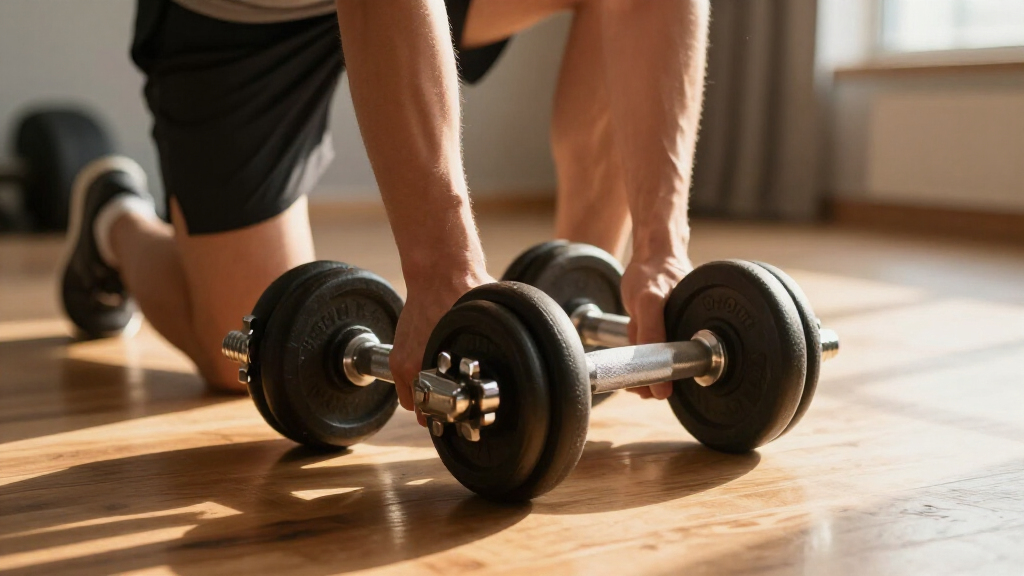
| Spin-lock | Threaded collars secure plates | Cheap, durable, easy to repair | Slow changes; interrupts circuits |
| Olympic-style loadable | Standard plates + collars | High max loads; cheap plates | Long sleeves feel awkward on curls |
Picture a typical Tuesday session: dumbbell rows at 60 lbs, then lateral raises at 15. With a dial system you twist and go. With spin-locks you unscrew four collars, shuffle plates, and re-tighten — a 90-second detour that kills your momentum mid-circuit [1].
The tradeoff cuts both ways. That dial mechanism contains moving parts and plastic, and one careless drop can knock plates out of alignment permanently. A spin-lock handle is basically a metal bar; short of losing it, there’s nothing to break.
The 5 Numbers That Decide Whether a Set Works for You
Five specs separate a great set from a paperweight, and none of them is the headline number on the box. Check them in this order:
- Minimum weight. If the lowest setting is 10 lbs and you need 5 lb lateral raises, the set fails on day one.
- Maximum weight per dumbbell. Compound moves like rows and goblet squats outgrow light sets fast — buy some capacity you don’t need yet [1].
- Increment size. Jumps of 2.5–5 lb keep progressive overload smooth; 10 lb leaps stall your presses for weeks.
- Handle length at light settings. Some dumbbells stay full-length even nearly empty, which makes them clumsy overhead.
- Price per usable pound. Compare the full package — pair, stand, expansion kits, warranty — not the sticker price [1].
Here’s a scenario every buyer should run: your lightest exercise and your heaviest exercise. If a set can’t serve both — say, 5 lb raises and 70 lb chest presses — you’ll end up buying twice. Expandable systems solve this by letting you add plates later, but only if the platform supports the kits.
Why Dropping Adjustable Dumbbells Is the #1 Way to Ruin Them
Most selectorized dumbbells are not droppable, and a single hard landing can bend the selector mechanism so plates never lock cleanly again [1]. This is the fine-print failure that turns a $500 purchase into scrap.
Gym habits die hard. If you’ve ever dumped dumbbells after a brutal set of presses — totally normal with fixed iron — you’ll need to retrain yourself. Selectorized models go back into their cradle, gently, every time. And remember that cradles aren’t optional with many dial systems: the dumbbell often must sit correctly in its base before you can change the weight at all [1].
Rubber flooring helps with noise and floor protection, but it doesn’t make a non-droppable dumbbell safe to drop [1]. Some heavy-duty systems tolerate limited impact — check the actual product rating rather than assuming.
Locking security is a safety issue, not a convenience feature. Before every overhead press, confirm the plates are fully engaged. A loose plate at arm’s length is how injuries happen.
Fine Print Traps: What Listings Don’t Put in the Headline
The most common adjustable dumbbell complaint isn’t quality — it’s surprise. Listings are written to sound bigger than they are, and heavy products are expensive to return. Read before you click.
- Pair or single? A ’90 lb set’ may mean two 45 lb dumbbells — or one 90 lb handle. Always confirm [1].
- Does the weight include the handle and cradle? Some brands count everything toward the total.
- Every increment, everywhere? Some ranges advertise increments that only exist in the middle of the range.
- Expansion kits included or extra? The cheap base set that needs a pricey add-on may cost more overall.
- Shipping and returns. These boxes weigh 100–300 lbs. Return shipping can exceed the product’s value.
Also measure your storage spot and your workout clearance first. A dumbbell that’s 16 inches long is fine for rows but can collide with your forearm during close-grip presses [1]. Dimensions affect daily usability more than max load does.
Do They Feel Like Real Dumbbells? (And Do Beginners Care?)
Adjustable dumbbells feel different from fixed ones — usually longer, sometimes wider, occasionally with a rattle from the plate clearance needed for the mechanism to work [1]. A slight rattle is normal; a loose, shifting feel is not, and usually means incorrect adjustment or wear.
For beginners, that difference barely matters. Starting light and creeping up in 2.5 lb steps is exactly how you learn technique without stalling, and fine increments are ideal for it [1]. Higher-quality compact systems — the ones that shorten as weight is removed — feel closest to conventional dumbbells.
Experienced lifters should be pickier. Check load capacity, handle knurling and diameter, and whether the balance suits heavy pressing. Recent premium models have added more metal components, quieter plate assemblies, and higher maximum loads aimed squarely at serious trainees [1].
Frequently Asked Questions
Are adjustable dumbbells worth it for a home gym?
For most home users, yes. They replace a full fixed-dumbbell rack at a fraction of the space and usually a lower total cost. Fixed dumbbells still win in commercial gyms, fast group workouts, or training that involves frequent dropping [1].
How heavy should my adjustable dumbbells be?
Buyers should pick a maximum based on current strength plus expected progression — compound lifts outgrow light sets quickly. A little unused capacity now is cheaper than replacing the whole set in a year [1].
Can adjustable dumbbells be dropped?
Many selectorized models should not be dropped at all; even a short fall can damage internal parts or stop plates from locking correctly. Rubber flooring reduces noise but doesn’t make a non-droppable model safe to drop [1].
Which is better: dial adjustment or spin-lock collars?
Dial systems are faster and better for circuits; spin-lock models are simpler, cheaper, and easier to repair. Choose based on whether workout speed or mechanical simplicity matters more to you [1].
How long do adjustable dumbbells last?
Simple metal plate-loaded systems can last many years with basic care. Selectorized systems can also last long, but their lifespan depends more on build quality, careful handling, and whether replacement parts are available [1].
Conclusion
If you train at home and space is finite, adjustable dumbbell sets are one of the rare fitness purchases where the hype is justified: a whole rack’s range in two handles. Buy for the range and increments you’ll need in two years, not today, and treat a dial system like the precision tool it is — cradled, never dropped.
The best set isn’t the heaviest or the cheapest. It’s the one whose plates lock with a confident click, every single rep.