TL;DR

Get workout gear delivered free with Prime
- Fast, free delivery on millions of items
- Prime Video, Amazon Music and more included
- Member-only deals all year
Fit&Well published a trainer’s account of three coordination exercises used in sessions with older adults: knee and opposite-arm raises, side step-outs with an opposite-arm reach, and ball catches. The exercises can be adapted for seated or standing practice, but the report does not establish that this specific routine improves longevity or provide evidence about its effects on falls.
Fit&Well has published a trainer’s account of three coordination exercises she uses with older adults, offering standing and seated versions intended to practise controlled movement across the arms and legs. The report presents the exercises as adaptable to different mobility levels, but it does not show that the specific routine extends lifespan or prevents falls.
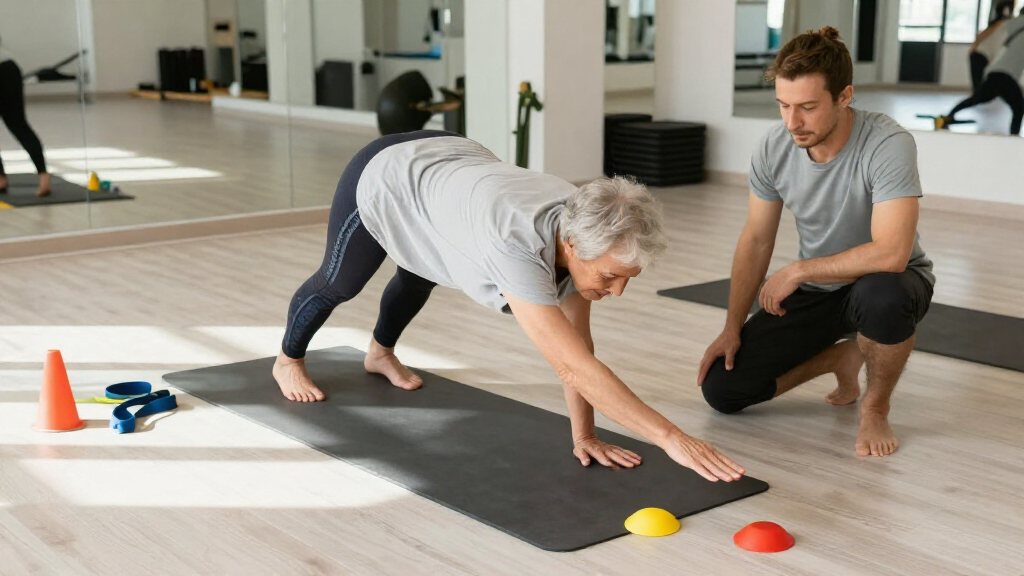
The trainer says she incorporates coordination work into chair-based yoga classes and personal-training sessions for older adults. Her stated aim is to practise the connection between thought and movement, and she says clients use the exercises to work on confidence and control during everyday tasks. Those are the trainer’s observations, rather than measured outcomes reported for the exercises.
The first move pairs a knee raise with the opposite arm. Standing participants raise one knee while moving the other arm forward, then switch sides; the report suggests five to six repetitions per side. A seated version uses a controlled march with the opposite arm lifting forward or overhead.
The second exercise combines a side step and opposite-arm reach, also for five to six repetitions per side. Participants step out to one side and reach the opposite arm forward. The trainer’s instructions allow people to remain upright or add a side lunge if comfortable; seated participants can step one foot out and open the opposite arm to the side. The third drill uses a ball: participants stand near a wall, lift one foot if able, gently throw the ball underhand to bounce it off the wall, and catch it. The report suggests five to 10 throws and says the task can be made easier by standing on both feet, sitting, or using a different-sized ball.
Coordination for Everyday Movement
The report’s practical point is that coordination exercises can be adjusted for mobility, rather than requiring every older adult to perform the same standing routine. The seated alternatives may make it possible to practise opposite-side movements without adding a balance challenge, while standing variations combine coordination with weight shifting or single-leg balance.
The trainer connects that practice with tasks such as moving around other people or managing more than one action at home. These examples explain why she includes the exercises, but the supplied report does not provide data showing that this exact sequence makes those activities safer or improves independence. Readers should distinguish the trainer’s experience from evidence of a proven health effect.
The exercises also involve different demands: the first two ask participants to coordinate a limb on each side of the body, while the ball drill adds catching and responding to movement. That makes it possible to vary the challenge, but a more difficult version is not automatically suitable for everyone. Someone who feels unsteady can use a seated option or practise with support nearby.
Products Worth Considering

Garmin Venu 3 Fitness Smartwatch, 45 mm, Black

Fitbit Versa 4 Fitness Smartwatch – Black/Graphite

Garmin Forerunner 570 GPS Running Smartwatch, 47mm, Aluminum, Black
As an affiliate, we earn on qualifying purchases.
How the Trainer Uses the Drills
The article frames coordination as a complement to strength training, not a replacement for it. The trainer says she includes the movements in chair-based yoga and personal-training sessions, with standing and seated options selected according to a client’s mobility. That is the basis for the report’s practical recommendations; it is not a clinical assessment or a prescription for every older adult.
Fit&Well also refers to a 2019 review of balance and coordination exercises in older adults. As summarized in the supplied material, the review found possible improvements in cognitive processes such as spatial awareness, along with postural control and stability in distracting environments. The source material does not give the review’s title, methods, participant numbers, or effect sizes, so those details cannot be independently assessed here.
The review’s findings concern balance and coordination exercises as a broad category. They should not be taken as proof that these three particular drills produce the same results, or that they extend lifespan. The source article’s longevity framing is broader than the evidence details provided in the supplied report.
“I always incorporate coordination training into my chair-based yoga classes and personal training sessions with older adults.”
— The trainer quoted in Fit&Well
Limits of the Available Evidence
The supplied report does not identify the trainer by name, give a publication date, or provide details such as the number of clients involved. It also does not include independent measurements of changes in coordination, confidence, falls, or daily function after doing the exercises.
Details of the 2019 review are limited in the source material, which summarizes its findings without naming the studies or describing their quality. It is therefore unclear how directly those findings apply to these three specific drills. The report also does not offer a tailored safety assessment for people with particular health conditions, pain, or substantial balance difficulties.
Adapting Practice to Ability
The source report gives no announced follow-up study or next publication. Its immediate guidance is to choose a version that matches current ability: practise seated if standing is uncomfortable or unsteady, use both feet for the ball drill before trying a one-foot balance, and keep movements slow and controlled. A stable support or another person nearby may help reduce the risk of losing balance during standing practice.
Anyone with a health condition, recent injury, or significant balance concern should seek advice from a qualified health professional before adding new exercises. The article does not establish that the routine is suitable for everyone, and it gives no evidence-based schedule beyond the suggested repetitions for each movement.
Key Questions
Which exercises did the trainer describe?
The report describes a knee raise with the opposite arm, a side step paired with an opposite-arm reach, and a ball throw-and-catch drill.
Can the exercises be done seated?
Yes. The report gives seated alternatives for all three: a controlled march with an opposite-arm lift, a seated side step with an arm opening, and a seated version of the ball drill.
Does the report prove these exercises prevent falls or extend life?
No. It reports the trainer’s approach and summarizes a 2019 review of balance and coordination exercises, but does not show that these three drills prevent falls or extend lifespan.
How many repetitions does the report suggest?
It suggests five to six repetitions per side for the first two exercises and five to 10 throws for the ball drill. The report does not provide a general weekly schedule.
Source: rss