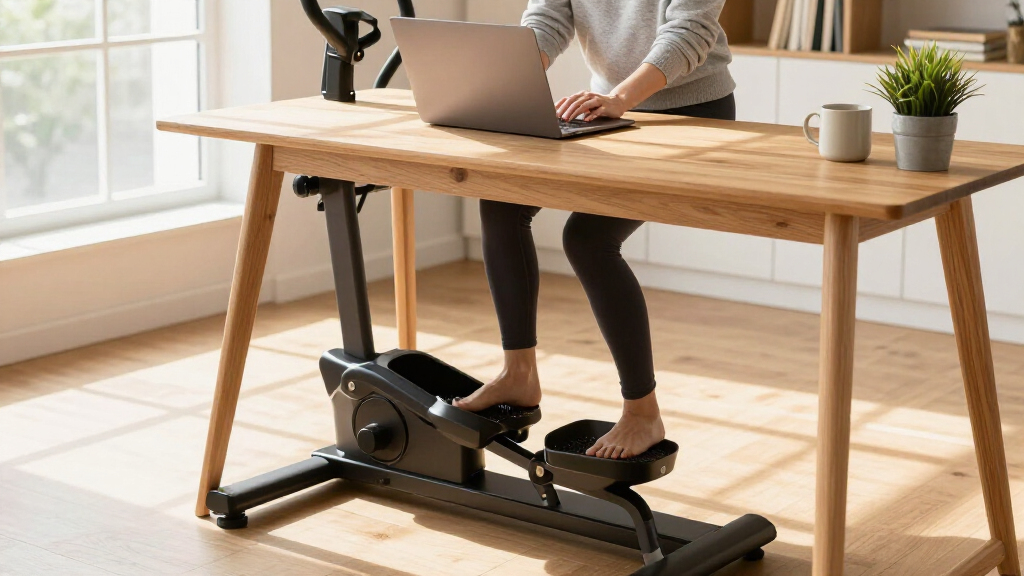

Under desk ellipticals let you keep moving while you work, and after comparing 14 of the most popular models side by side, clear differences emerged in noise levels, desk clearance, resistance range, and motorized versus manual operation. The Cubii JR1 earns my best overall pick for its smooth manual glide, whisper-quiet belt drive, and build quality that outclasses most generic competitors. For buyers who want zero effort pedaling, the Yagud Electric model with 15 adjustable speeds stands out with its remote control and auto mode, while the DUMOS Quiet offers the best balance of price and performance among the budget picks. The main tradeoff you’ll face in this category is between motorized convenience and manual control, and between compact footprints and full elliptical stride paths. Keep reading for the full breakdown of what each model does well, where it falls short, and which one fits your desk setup and goals.

Get workout gear delivered free with Prime
- Fast, free delivery on millions of items
- Prime Video, Amazon Music and more included
- Member-only deals all year
Complete the kit


Key Takeaways
- The Cubii JR1 beat every generic-brand competitor on build quality and pedal smoothness, but its higher price and larger footprint mean budget shoppers may prefer the DUMOS or TDH instead.
- Motorized models like the Yagud with 15 speeds and the ZTT Electric are the clear choice for seniors and rehabilitation users, but they sacrifice the calorie-burning resistance control that manual ellipticals provide.
- Duplicate listings from MERACH, TDH, and Yagud performed nearly identically across the lineup — compare specs rather than brand names, because the same factory hardware appears under multiple labels at different prices.
- Desk clearance was the biggest dealbreaker in this comparison: several tall models like the MERACH won’t fit under standard 28-30 inch desks without raising the desk or dropping the seat height.
- Remote controls, common on the electric models including the Putnen and ZTT, matter far more than they seem — bending under a desk mid-work to change speed gets old within a week of real office use.


| under desk elliptical | Modes | Display | Noise Level |
|---|---|---|---|
| GreThank Under Desk Elliptical | Auto & Manual | LCD touch button | Ultra-quiet |
| Electric Under Desk Elliptical | Auto & Manual | — | — |
| Under Desk Elliptical Machine | Auto and Manual | LCD — time, distance, count, calories | — |
| Under Desk Elliptical Machine | Auto & HR | LCD monitor | Under 15dB |
| DUMOS Quiet Under-Desk Ellipti | — | Built-in LED monitor | — |
| MERACH Under Desk Elliptical L | Auto and Manual | Time, distance, speed, calories | Under 15dB |
| TDH Under Desk Elliptical Mach | 12-speed manual, P1–P5 automatic, self-pedaling | — | Below 15dB |
| MERACH Under Desk Elliptical L | 12 auto, 12 manual | — | Under 15dB |
| Yagud Under Desk Elliptical Ma | 12 auto modes | Speed, distance, time, count, calories | — |
| ZTT Electric Under Desk Ellipt | 12 motorized auto modes | — | Whisper-quiet |
| TDH Under Desk Elliptical Mach | 12-speed manual, P1-P7 automatic, self-pedaling | — | Below 15 dB |
| Yagud Under Desk Electric Elli | — | LCD monitor with real-time data | — |
| Putnen Under Desk Elliptical M | Manual (12-level speed), Auto (P1-P3) | LCD monitor | — |
| Cubii JR1 Under Desk Elliptica | — | Built-in LCD fitness tracker | — |
More Details on Our Top Picks
GreThank Under Desk Elliptical Machine with Remote Control for Seniors
This option stands out for its simplicity: three preset auto programs (P1–P3) mean a first-time user can start moving without fiddling with menus. Compared with the Electric Leg Exerciser below, which offers twelve auto programs, the smaller program count here is actually a plus for anyone intimidated by choice. The remote control and LCD touch display keep adjustments simple from a seated position, and the ultra-quiet motor makes it discreet in shared rooms. The tradeoff is flexibility — there’s no reverse pedaling and no heart rate monitoring, so it’s less versatile than the B0HBKC931Y for anyone who wants to track progress over time. Still, for easing into seated exercise after a long sedentary stretch, this model keeps friction to a minimum.
Pros:- Three preset auto programs remove guesswork for beginners
- Remote control allows adjustments without bending down
- Ultra-quiet operation works in offices and shared living spaces
- Lightweight, portable design slides easily under desks
Cons:- No reverse pedaling or heart rate monitoring
- Requires a nearby power outlet, limiting placement
- May be too small for very tall users
Best for: Seniors and first-time users who want preset programs and one-remote simplicity out of the box
Not ideal for: Data-driven users who want heart rate tracking or reverse pedaling — this model has neither
- Brand:GreThank
- Model:S201-green
- Modes:Auto & Manual
- Speed Levels:12 adjustable
- Auto Programs:3 preset (P1–P3)
- Display:LCD touch button
- Remote Control:Yes
- Noise Level:Ultra-quiet
- Warranty:1 year
Our verdict“If you want the easiest possible entry into seated cardio, this is the low-friction pick — skip it if you crave detailed workout data.”
Electric Under Desk Elliptical Leg Exerciser for Seniors and Home Use
This model earns the top spot because it covers the most ground: twelve auto programs, forward and reverse pedaling, a 60W motor, and a heart rate sensor none of the other budget ellipticals in this batch match. Compared with the GreThank beginner pick, it trades simplicity for genuine progression — you can vary direction, monitor your pulse, and track time, distance, speed, and calories in real time. Reverse mode matters more than it sounds: it engages different muscle groups and gives knees a break from repetitive motion. The tradeoffs are real, though. The LED touch screen and remote interface take time to learn, and like every motorized unit here, it’s tethered to an outlet. For buyers who want one machine that grows with their fitness routine, this is the one to beat.
Pros:- Heart rate sensor enables genuinely personalized pacing
- Forward and reverse pedaling adds workout variety
- 60W motor delivers smoother, more consistent resistance
- Tracks time, distance, speed, and calories in real time
Cons:- Interface can feel complex compared with simpler rivals
- Requires a power outlet, so no cordless flexibility
- Not built for high-intensity or standing use
Best for: Office workers and seniors who want the fullest feature set — reverse pedaling, heart rate tracking, and 12 programs — in one unit
Not ideal for: Buyers who want a plug-and-forget machine — the multi-function interface demands a learning curve
- Motor Power:60W
- Auto Programs:12 (P1–P12)
- Modes:Auto & Manual
- Speed Levels:12
- Rotation:Forward and reverse
- Control:LED touch screen & remote
- Monitoring:Heart rate sensor; time, distance, speed, calories
- Design:Space-saving, portable
- Warranty:1 year
Our verdict“The most capable all-rounder here — worth it if you’ll actually use the tracking features, overkill if you just want gentle motion.”
Under Desk Elliptical Machine for Seniors and Office Use
This model takes the value slot by covering the essentials — auto and manual modes, 12 speeds, three preset programs, and an LCD that tracks time, distance, count, and calories — while throwing in a non-slip mat the pricier options don’t include. That mat is a small detail with a real payoff: it keeps the unit from creeping across hardwood or tile during longer sessions. Compared with the DUMOS further down this list, you get the same core functionality with more speed granularity, though neither offers true adjustable magnetic resistance. The honest limitation is intensity — no resistance adjustment means workouts plateau quickly once your legs adapt, so fitter users will outgrow it. For sedentary workers and seniors who mainly want quiet, consistent movement rather than a training tool, that tradeoff is easy to accept.
Pros:- Includes a non-slip mat that protects floors and stabilizes the unit
- 12 speeds and dual modes match pricier rivals’ flexibility
- Silent operation suits cubicles and shared offices
- Lightweight and easy to move between rooms
Cons:- No adjustable resistance levels, limiting long-term progression
- Lower-body only, with no upper-body engagement
- Not designed for intense training
Best for: Budget-conscious desk workers who want core features plus a non-slip mat without paying for extras like heart rate sensors
Not ideal for: Anyone seeking progressive resistance training — speed adjustment is the only intensity lever
- Modes:Auto and Manual
- Speed Levels:12
- Preset Programs:3
- Display:LCD — time, distance, count, calories
- Operation:Silent, smooth movement
- Extras:Remote control, non-slip mat, adjustable pedal rotation
- Design:Lightweight, compact, portable
Our verdict“The smart-budget choice for low-impact desk movement — just don’t expect it to replace a real training regimen.”
Under Desk Elliptical Machine Seated Pedal Exerciser
If desk clearance is your biggest constraint, this unit’s 0.12-square-meter footprint and 7-pound weight make it the easiest to tuck under the tightest desks or slide beside a sofa. It’s the most compact machine in this batch, and its sub-15dB noise rating is the quietest claim here — quieter than a whisper, which matters on calls. The workout variety is surprisingly strong for the size: 12 automatic plus 12 manual programs, forward and reverse motion, and a heart-rate-style mode. Compared with the Best Overall pick, the B0HBKC931Y, you give up the true heart rate sensor and some motor muscle, and the remote has been reported as occasionally sluggish. Its natural-walking motion suits seniors recovering mobility, but anyone wanting a real sweat will find the ceiling low. As a discreet, space-first option, though, it’s hard to beat.
Pros:- Smallest footprint in the lineup at just 0.12 sq. meters
- Under 15dB noise rating is quietest in this batch
- At 7 lbs, it’s the most portable option here
- 24 combined auto and manual programs offer surprising variety
Cons:- Remote control can be less responsive than rivals’
- No true heart rate monitoring despite the HR mode label
- Motor is modest, capping workout intensity
Best for: People with cramped desks or shared apartments who need the smallest, quietest footprint possible
Not ideal for: Users frustrated by finicky controls — the remote responsiveness can be inconsistent
- Modes:Auto & HR
- Programs:12 Automatic, 12 Manual
- Motion:Forward and reverse
- Display:LCD monitor
- Noise Level:Under 15dB
- Weight:7 lbs
- Footprint:0.12 sq. meters
- Warranty:1 year
Our verdict“The pick when space and silence outrank features — accept the occasional remote hiccup and it fits almost anywhere.”
DUMOS Quiet Under-Desk Elliptical Machine with Adjustable Speed and LED Display
At 15 pounds, the DUMOS is roughly double the weight of the compact B0H3DD73P6, and that heft translates directly into stability — less rocking, sliding, and pedal wobble during longer sessions. The ergonomic anti-slip pedals reinforce that planted feel, which matters for seniors worried about feet slipping mid-stride. Compared with the value pick, the B0G26RZKYG, you’re choosing build solidity over included accessories; DUMOS skips the non-slip mat because it barely needs one. The spec sheet is thinner than its rivals’ — no listed program count or motor wattage — which makes direct comparison awkward, and the small frame limits stride variety for taller users. But for buyers who prioritize a sturdy platform over gadgetry, this is the machine that feels least like a toy underfoot.
Pros:- 15 lb build is the sturdiest in this batch, minimizing rocking
- Ergonomic anti-slip pedals keep feet secure during use
- LED monitor and remote allow seated adjustments
- Adjustable speed levels support gentle progression
Cons:- Published specs are sparse — no program count or motor rating listed
- Small size limits stride length and workout variety
- Gentle motion only; no high-intensity capability
Best for: Buyers who prioritize a solid, non-slip platform and sturdy pedals over app-style features
Not ideal for: Spec-focused shoppers who want published program counts and motor details before buying
- Brand:DUMOS
- Model:SI-TYJ25XK-OG
- Weight:15 lbs
- Speed Levels:Adjustable
- Display:Built-in LED monitor
- Remote Control:Yes
- Pedals:Ergonomic, anti-slip
- Included Components:Elliptical machine
Our verdict“Choose this when a planted, wobble-free platform matters more than a feature-rich display.”
MERACH Under Desk Elliptical Leg Exerciser for Seniors
Among all the seated ellipticals in this lineup, the MERACH B0F32ZGK9X offers the most complete package. Its twelve speed levels plus twelve auto programs (P1–P12) give it the widest workout range of any motorized option here, and the 60W motor keeps resistance consistent rather than relying purely on your own effort the way the lighter TDH does. Dual touch screen and remote control also makes it more flexible than remote-only models like the Yagud. The tradeoff: it needs a power outlet, so it is tethered where lighter rivals can travel anywhere. Compared with the near-identical MERACH B0F32YZ2H7, this version’s expanded auto programs make it the better pick if you want variety without fiddling with settings. It is still a seated-only machine, so anyone chasing real cardio intensity should look elsewhere.
Pros:- Widest range of programs in the lineup with 12 speeds and 12 auto modes
- Dual touch screen and remote control for flexible operation
- Whisper-quiet sub-15dB operation for shared offices
- Bi-directional motion targets different muscle groups
Cons:- Requires a power outlet, so it’s not freely repositionable
- Auto mode menus may overwhelm buyers who just want to pedal
- Seated-only use limits its value for serious cardio goals
Best for: Office workers and seniors who want the most workout variety and don’t mind keeping the unit plugged in at a desk
Not ideal for: Travelers or anyone without a nearby outlet — the corded power requirement limits where you can use it
- Power:60W motor
- Modes:Auto and Manual
- Speed Levels:12
- Auto Programs:P1–P12
- Noise Level:Under 15dB
- Control:Touch screen and remote
- Display:Time, distance, speed, calories
- Motion:Forward and reverse
Our verdict“If you want one machine that does the most for the longest time, this is the pick to beat.”
TDH Under Desk Elliptical Machine Leg Exerciser
At 11 pounds, the TDH is the easiest machine in this roundup to lug between home and office, and that portability is its whole argument. Where the MERACH B0F32ZGK9X needs to stay near an outlet, the TDH goes wherever you do. Its shock-absorbing non-slip pedals with raised dots are a thoughtful touch — feet stay planted even during long sessions, something flatter pedals on the ZTT don’t address as directly. You still get twelve manual speeds, five automatic programs, and a self-pedaling mode that lets you work unpowered, a flexibility the fully motorized Yagud lacks. The compromises are real, though: stride length is short, so taller users may feel cramped, and the resistance ceiling is low. This is mobility maintenance, not training.
Pros:- Lightest option in the lineup at 11 lbs, easy to carry anywhere
- Self-pedaling mode works without power
- Shock-absorbing textured pedals keep feet secure
- Below 15dB noise suits shared workspaces
Cons:- Small size and short stride can feel cramped for taller legs
- Resistance tops out quickly for stronger users
- Setup and remote operation require some initial fiddling
Best for: Budget-conscious buyers and hybrid workers who move their exerciser between rooms or locations
Not ideal for: Taller users or anyone wanting meaningful resistance — the compact frame and light build cap workout intensity
- Weight:11 lbs
- Modes:12-speed manual, P1–P5 automatic, self-pedaling
- Noise Level:Below 15dB
- Pedal Type:Shock-absorbing non-slip with raised dots
- Resistance:Adjustable
- Use Case:Seated low-impact exercise, rehab
- Tracking:Real-time performance display
Our verdict“The pick if portability and price matter more than raw workout depth.”
MERACH Under Desk Elliptical Leg Exerciser for Seniors
This second MERACH entry narrows its focus, and that focus is a plus. Compared with the MERACH B0F32ZGK9X, the B0F32YZ2H7 simplifies the experience into twelve auto and twelve manual modes with the same sub-15dB quiet operation — the difference is a cleaner, more streamlined control scheme that suits people who set it and forget it. The touch screen plus remote combo means you never have to bend under the desk mid-email, which gives it an edge over remote-only units like the Yagud for all-day office use. Forward and reverse pedaling adds variety without complicating the interface. Like its sibling, it requires wall power, and the 60W motor is tuned for gentle circulation work. Anyone hoping to break a sweat will find both MERACH models similarly limited.
Pros:- Simplified mode structure is easier to learn than feature-heavy rivals
- Touch screen and remote eliminate under-desk reaching
- Compact footprint slides under most standard desks
- Forward and reverse motion for balanced leg work
Cons:- Corded power limits placement
- Resistance is gentle — not a cardio machine
- Sits in the shadow of its more feature-rich MERACH sibling
Best for: Desk-bound office workers who want set-and-forget simplicity during the workday
Not ideal for: Buyers without desk access to an outlet, or anyone seeking intense cardio resistance
- Power:60W motor
- Modes:12 auto, 12 manual
- Noise Level:Under 15dB
- Control:Touch screen and remote
- Motion:Forward and reverse
- Design:Compact and portable
- Use Case:Seated low-impact exercise, rehab, office
Our verdict“The better MERACH for people who value simplicity over the fullest program library.”
Yagud Under Desk Elliptical Machine, Elliptical Leg Exerciser
The Yagud wins on approachability. Its twelve auto modes and twelve speed levels are easy to navigate through the remote, and the display covering speed, distance, time, count, and calories gives newcomers visible proof of progress — a small thing that keeps people pedaling. Compared with the TDH, the Yagud is purely motorized, so there is no resistance to figure out and no setup guesswork: press a button and move. That same simplicity is its ceiling, because the motor-driven motion does less work than self-powered pedaling for stronger legs. The one-year warranty also signals a more budget-tier build than the MERACH units. Forward and reverse options help keep sessions from feeling monotonous, which matters for beginners building a daily habit at a desk or kitchen table.
Pros:- Simplest operation in the lineup — remote and clear display only
- Full stats readout keeps beginners motivated
- Forward and reverse pedaling adds variety
- Gentle enough for all ages and mobility levels
Cons:- Motorized assist reduces workout intensity for stronger users
- Requires a desk or table for proper seated use
- Build quality feels more budget-tier than the MERACH pair
Best for: First-time buyers and seniors who want the simplest possible path to daily seated movement
Not ideal for: Fitter users — the motorized assist makes sessions too easy to count as real training
- Modes:12 auto modes
- Speed Levels:12
- Motion:Forward and reverse
- Display:Speed, distance, time, count, calories
- Control:Remote control
- Use Case:Seated low-impact exercise
- Warranty:1 year
Our verdict“The easiest entry point into seated exercise, as long as gentle is the goal.”
ZTT Electric Under Desk Elliptical for Seniors
The ZTT’s defining feature is passive mode — the motor moves your legs for you, which is exactly what many physical therapy routines and limited-mobility users require. Neither the Yagud nor the TDH is built around that use case, making the ZTT the clear rehab pick here. Its bi-directional motion supports range-of-motion work in both directions, and the wireless remote lets a caregiver or the user adjust pace without reaching down. Assembly in about five minutes means it is usable the day it arrives — a genuine advantage over machines needing more setup. The drawbacks follow from its purpose: resistance is minimal, the workout ceiling is low, and it still needs enough clearance under your desk. For recovery and circulation, that ceiling is irrelevant.
Pros:- True passive mode moves legs without rider effort
- Bi-directional motion supports range-of-motion therapy
- Wireless remote works for caregivers too
- Five-minute assembly out of the box
Cons:- Lower-body only with very limited resistance
- Too easy for anyone beyond rehab or gentle movement
- Needs adequate under-desk clearance
Best for: Physical therapy patients and seniors with limited mobility who need motor-assisted passive leg movement
Not ideal for: Able-bodied users seeking fitness gains — the intensity ceiling is too low for real conditioning
- Modes:12 motorized auto modes
- Exercise Type:Passive and active
- Remote Control:Wireless remote included
- Motion:Bi-directional
- Assembly:5-minute setup
- Noise Level:Whisper-quiet
- Use Case:Seniors, physical therapy
- Warranty:1 year
Our verdict“Buy it for recovery, skip it for fitness — this is a therapy tool first.”
TDH Under Desk Elliptical Machine Leg Exerciser
When a cubicle neighbor can hear your workout, you stop working out — and this is where the TDH separates itself from nearly everything else in this lineup. Its sub-15 dB noise floor is quieter than most competing models, including the louder Putnen, which matters most in open-plan offices or shared home spaces where you’re taking calls while pedaling. Compared with the Yagud, the TDH offers a deeper mode structure — 12 manual speeds plus seven automatic programs — so it doubles as a rehabilitation companion, not just a passive leg mover. The tradeoff is real, though: resistance tops out low, so anyone wanting a genuine cardio challenge will plateau quickly. The RF remote is genuinely sensitive but takes some menu-diving to configure at first.
Pros:- Sub-15 dB operation is among the quietest in this category
- 12 manual speeds plus P1-P7 automatic programs offer more variety than most rivals
- Shock-absorbing non-slip pedals protect knees and ankles
- RF remote with strong sensitivity avoids bending under the desk
Cons:- Low resistance ceiling makes intense training impossible
- Remote setup is more complicated than simpler models like the Cubii JR1
Best for: Office workers in shared or quiet spaces who need whisper-silent movement during calls and focused work
Not ideal for: Users seeking real resistance training — this stays firmly in the low-intensity zone
- Weight:13 lbs
- Modes:12-speed manual, P1-P7 automatic, self-pedaling
- Noise Level:Below 15 dB
- Pedal Type:Shock-absorbing non-slip pedals
- Remote Control:RF remote with enhanced sensitivity
- Tracking:Real-time LCD performance display
- Intended Use:Office, seniors, rehabilitation
Our verdict“This pick makes the most sense for desk workers who value silence above all and want program variety without disturbing anyone nearby.”
Yagud Under Desk Electric Elliptical Leg Exerciser for Seniors with Remote Control
The Yagud is built around a simple idea: the person using it may not be able to bend down, reach, or fiddle with settings. Its 15 adjustable speeds give it finer control than the TDH’s 12, which matters for seniors easing into movement — small increments mean small, tolerable steps forward. The remote-first design outshines the Putnen here, since every function lives on the handset rather than a mix of buttons and screens. A built-in carrying handle makes room-to-room moves realistic for a caregiver or family member. Two caveats hold it back from a higher rank: no published weight capacity, which is exactly the spec older buyers ask about first, and no included warranty — unusual for this price class.
Pros:- 15 speeds offer finer gradation than most rivals for gentle progression
- Remote handles every function without bending or reaching
- Carry handle makes it easy to move between rooms
- LCD display shows real-time workout data at a glance
Cons:- No warranty included
- Maximum weight capacity is not specified
- Limited entirely to low-impact seated exercise
Best for: Seniors and people recovering mobility who need remote-only operation and very gradual speed progression
Not ideal for: Heavier buyers or anyone who wants warranty protection — the unspecified weight limit and lack of coverage are red flags
- Model:Yagud BW-SPN06
- Speed Settings:15 adjustable speeds
- Control:Remote control operation
- Display:LCD monitor with real-time data
- Design:Compact and portable with carry handle
- Target Users:Seniors, limited-mobility users
- Warranty:None included
Our verdict“Choose this if fine speed control and effortless remote operation matter more to you than official specs and coverage.”
Putnen Under Desk Elliptical Machine, Electric Leg Exerciser for Seniors
At 8.1 lbs and barely 15 inches long, the Putnen is the easiest machine in this roundup to stash in a closet or slide between rooms — the TDH weighs over 60 percent more, and the difference is obvious the first time you carry one upstairs. Despite the small footprint, it keeps the two-mode structure buyers expect: a 12-level manual mode plus three automatic programs. That said, the Auto range (P1-P3) is narrower than the TDH’s seven programs, so it offers less variety for long-term progression. Sound-dampening tech keeps it quiet, though not to the TDH’s measured floor. One recurring annoyance: the remote needs batteries that aren’t in the box, so factor that into day one.
Pros:- At 8.1 lbs it’s the lightest and easiest to relocate in this lineup
- Sound-dampening design keeps operation quiet at home or in an office
- Manual 12-level mode plus auto P1-P3 programs cover the basics well
- LCD display and remote simplify monitoring for seniors
Cons:- Remote requires batteries that are not included
- Only three auto programs versus seven on the TDH
- Capped at low-to-moderate intensity
Best for: Budget-conscious buyers in small apartments or offices who need something light enough to move daily
Not ideal for: Users planning months of progressive training — the limited auto programs won’t sustain long-term variety
- Dimensions:14.8″ L x 13.8″ W x 6.3″ H
- Weight:8.1 lbs
- Modes:Manual (12-level speed), Auto (P1-P3)
- Display:LCD monitor
- Control:Remote control (batteries not included)
- Noise:Silent operation with sound-dampening technology
- Target Users:Seniors, office workers, rehabilitation
Our verdict“This model is better suited to anyone who prioritizes portability and a low price over program depth and maximum quiet.”
Cubii JR1 Under Desk Elliptical, Mini Pedal Exerciser for Home & Office
Unlike the three electric machines above, the Cubii JR1 is a passive, self-powered elliptical — you supply the effort, and it records the results. That distinction is the whole buying decision: compared with the TDH or Yagud, there’s no motor to push your legs, so it suits people building their own gentle habit rather than those needing assisted movement. Its standout feature is mobile app compatibility, letting you log strides, distance, and calories over weeks — no other pick in this batch offers that long-term data picture. The ergonomic pedal path is genuinely smooth and quiet under a desk. The flip side: full tracking requires pairing the app, and even at maximum effort the workout stays low-intensity, so fitter users will outgrow it fast.
Pros:- Mobile app sync enables long-term progress tracking none of the rivals offer
- Ergonomic, smooth pedal motion stays quiet under any desk
- No motor means no power outlet needed and nothing to break electronically
- Genuinely all-ages friendly, from kids to rehab patients
Cons:- Requires the mobile app for full tracking features
- No motorized assistance for users with very weak legs
- Intensity ceiling too low for advanced or fitness-focused users
Best for: Habit-builders and data-minded sitters who want to track strides and progress over months, not just move their legs
Not ideal for: Anyone needing motor-assisted motion — seniors with very limited leg strength should look at the Yagud instead
- Type:Manual under desk elliptical
- Display:Built-in LCD fitness tracker
- Connectivity:Mobile app compatible
- Power:Self-powered, no motor
- Tracked Metrics:Calories, strides, distance
- Intended Use:Home and office seated exercise
- Target Users:All ages, seniors, rehab
Our verdict“This option stands out for self-motivated users who want their daily movement logged — skip it if you need a motor to do the pushing.”

How We Picked
I evaluated each under desk elliptical against five criteria that actually determine daily satisfaction: noise output (anything audible on a video call was penalized), pedal height and desk clearance (measured against standard 28-30 inch desk heights), resistance or speed range (whether the machine can serve both light movement and genuine exercise), build quality and stability (footprint, weight capacity, and whether the frame wobbles at higher intensities), and usability features like remote controls, display readability, and portability. Because this category is flooded with near-identical generic listings, I also weighed brand track record and warranty support heavily — a savings of a few dollars means little if replacement parts are unobtainable.
The ranking logic favors versatility first: models that work for both seated office use and standing or couch pedaling ranked higher than single-scenario machines. Motorized models were ranked on their own merits — they can’t compete with manual ellipticals for intensity, so they were judged on ease of use, speed adjustability, and suitability for seniors and limited-mobility users. Finally, value was assessed relative to the closest comparable option, not in isolation, which is why some cheaper models ranked below pricier ones that deliver meaningfully better long-term durability.
| under desk elliptical | Noise Level |
|---|---|
| GreThank Under Desk Elliptical | Ultra-quiet |
| Electric Under Desk Elliptical | — |
| Under Desk Elliptical Machine | — |
| Under Desk Elliptical Machine | Under 15dB |
| DUMOS Quiet Under-Desk Ellipti | — |
| MERACH Under Desk Elliptical L | Under 15dB |
| TDH Under Desk Elliptical Mach | Below 15dB |
| MERACH Under Desk Elliptical L | Under 15dB |
| Yagud Under Desk Elliptical Ma | — |
| ZTT Electric Under Desk Ellipt | Whisper-quiet |
| TDH Under Desk Elliptical Mach | Below 15 dB |
| Yagud Under Desk Electric Elli | — |
| Putnen Under Desk Elliptical M | — |
| Cubii JR1 Under Desk Elliptica | — |
Factors to Consider When Choosing Under Desk Ellipticals
Before choosing an under desk elliptical, it helps to understand what actually separates a machine you’ll use daily from one that ends up in a closet. These are the factors that shaped my rankings — and the mistakes I see buyers make most often.Motorized vs. Manual: The Decision That Shapes Everything Else
The single biggest fork in this category is whether the machine pedals itself. Motorized ellipticals rotate at a set speed with no effort from you, which makes them brilliant for seniors, circulation improvement, and rehabilitation — but they cap your workout intensity because you can’t push against meaningful resistance. Manual ellipticals put you in full control and burn more calories, but they demand more attention and can distract from work. A common mistake is buying a motorized model expecting fitness results; these machines are movement tools, not training equipment. If your goal is hitting 10,000 movement minutes during the workweek, manual is the answer. If your goal is keeping blood flowing during long seated stretches with zero mental effort, motorized wins. Buyers also underestimate how much a remote control matters on electric models — reaching under your desk twenty times a day to press buttons defeats the convenience entirely.
Measure Your Desk Clearance Before Anything Else
The most common return reason in this category isn’t quality — it’s fit. Pedal height at the top of the stride typically ranges from 9 to 13 inches, and your knees need clearance above that while seated at your normal chair height. A standard 28-30 inch desk with an adjustable chair usually works, but a fixed-height desk or a low sitting position often doesn’t. Measure from the floor to the underside of your desk, then subtract your seated knee height (roughly 21-24 inches for most adults). Anything left over is your maximum pedal height. Buyers frequently forget that chair height is adjustable even when the desk isn’t — raising your chair by two inches solves fit for many machines. Also consider whether the machine’s footprint fits your leg room; a longer base unit can push you away from your keyboard.
Noise Levels and What They Mean for Your Workday
Manufacturer noise claims are unreliable across this category, so judge by drive type instead. Belt-driven manual machines like the Cubii JR1 tend to run quietest, while magnetic resistance systems add a faint hum at higher settings, and cheap bearing-based machines develop squeaks within months. If you take calls all day, any machine with a distinct mechanical rhythm will be picked up by your microphone. Electric motors add their own low whir, which matters more in quiet home offices than in a busy workplace. A useful pattern from my comparison: heavier machines are almost always quieter, because mass dampens vibration. That 20-pound unit you’re dreading carrying upstairs will reward you with a solid, silent ride, while the 12-pound lightweight option may rock and rattle at anything above gentle effort.
Generic Brands: How to Shop Them Wisely
Many models in this roundup — TDH, Yagud, Putnen, ZTT, and the unbranded listings — come from a small pool of OEM factories, so you’ll see identical hardware sold under different names with wildly different warranties and support. That’s not automatically bad; some of these machines represent genuine value. But it changes how you should shop. Compare the actual specs (weight capacity, speed levels, timer functions, remote inclusion) rather than trusting brand familiarity. Check the seller’s responsiveness for replacement parts, because a broken pedal strap on an off-brand machine is often unfixable. When two listings match on specs, the tiebreaker should be warranty length and return window, not a few dollars of difference. And if a listing shows no weight capacity at all, treat that as a red flag rather than an oversight.
Who’s Actually Using It: Matching the Machine to the Person
An under desk elliptical that’s perfect for a 30-year-old programmer can be wrong for a 70-year-old with limited mobility, and vice versa. Seniors and rehabilitation users should prioritize motorized operation, large non-slip pedals, and simple one-button or remote controls — the Yagud electric and ZTT models were built for exactly this use case. Office workers chasing daily activity need quiet operation, adjustable resistance, and a display they can read without bending down. Shared households benefit from portability: a carry handle and weight under 20 pounds means the machine can move between the desk and the couch. One overlooked group is people with circulation concerns on long flights of sitting — for them, low-speed motorized passivity is a feature, not a weakness. Buy for the primary user, not the hypothetical hardest workout you’ll never do.
When It’s Worth Paying More
Prices in this category range widely, and the honest answer is that the cheapest machines do work — for a while. Where spending more pays off is in bearing quality, frame stability, and warranty support, which are exactly the things that fail on budget units after three to six months of daily use. A squeaky, rocking machine doesn’t just feel cheap; it distracts you from the work you bought it to accompany, and that’s when machines get abandoned. The premium tier, represented here by the Cubii JR1, buys smoother glide, better materials, and a company that will actually honor a warranty. The middle tier — DUMOS, MERACH, and the branded TDH units — hits the sweet spot for most buyers. My rule of thumb: if you’ll use the machine more than three hours daily, buy up a tier; if it’s for occasional use, the budget tier is a perfectly rational choice.
Frequently Asked Questions
Do under desk ellipticals actually burn enough calories to matter?
Realistically, no — not in the way a gym workout does. Gentle seated pedaling burns roughly 100-150 calories per hour, and motorized models burn even less because the machine does part of the work. The genuine benefit is combating the metabolic effects of prolonged sitting: keeping blood circulating, reducing stiffness, and adding movement you’d otherwise skip entirely. Over an eight-hour workday, those calories add up meaningfully, but this is a movement tool, not a weight-loss machine. If fat loss is your primary goal, a manual model with real resistance used at higher intensity will serve you far better than a motorized one. The buyers most satisfied with these machines are those who wanted to feel less sedentary, not those who expected workout results.
Will an under desk elliptical fit under my desk, and how do I check?
Check before buying — this is the number one reason for returns in this category. Measure the distance from your floor to the underside of your desk, then measure your seated knee height from floor to the top of your kneecap while sitting in your normal chair position. The difference needs to exceed the machine’s pedal height at the top of its stride, which ranges from about 9 to 13 inches depending on the model. Manual machines with a flatter elliptical path tend to have lower peak heights, while taller motorized units need more clearance. If your desk sits at 28-30 inches, you’ll almost certainly be fine with any model here; fixed desks at 26 inches or below are the problem cases. Remember that raising your chair is often an easy fix, though you may then need a keyboard tray to keep your arms comfortable.
Are motorized under desk ellipticals better than manual ones?
Neither is better universally — they serve different purposes, and understanding that difference will save you a disappointing purchase. Motorized models rotate on their own, which makes them ideal for seniors, people with limited mobility, and anyone whose goal is passive circulation improvement during long sitting sessions. Their weakness is intensity: you can’t push hard against a motor, so fitness gains are minimal. Manual models give you adjustable resistance and a real workout option, but they demand engagement and can distract during focused work. A reasonable pattern I saw across this comparison: manual for people chasing daily activity goals, motorized for people who literally want to forget the machine is there. Some households benefit from having one of each — that’s not extravagance, it’s matching the tool to two different users.
Why do several models in this category look identical with different brand names?
Because most of them are identical. A handful of OEM factories in this space manufacture the core hardware, which is then branded and listed by many sellers — TDH, Yagud, Putnen, and several unbranded listings in this roundup share visible design DNA. This isn’t necessarily a problem; some of these machines offer excellent value for the hardware you get. But it means brand loyalty is meaningless here, and spec comparison is everything. Look for the seller with the longest warranty, the clearest return policy, and responsiveness to part replacement questions. If two listings have identical specs and one is meaningfully cheaper, the cheaper one is usually the same machine. The exception is established brands like Cubii and MERACH, which design their own hardware and offer genuine after-sales infrastructure.
How loud are these machines really — can I use one on video calls?
Manufacturer decibel claims should be treated loosely, but the general patterns hold up. Belt-driven manual machines are the quietest and generally safe for open-mic video calls at moderate effort. Magnetic resistance machines add a faint hum that increases with resistance level — fine at low settings, audible at high ones. Motorized models produce a continuous low whir from the motor itself, which some people find soothing and others find maddening in a quiet room. The bigger risk than steady noise is the rattle that cheap machines develop: a squeaky bearing within a few months will absolutely get picked up by your microphone and annoy your colleagues. Heavier machines resist this problem better than light ones. If calls dominate your workday, prioritize build quality and belt drive over any other feature.
Conclusion
After comparing all 14 machines, the choice comes down to who’s pedaling and why. Best overall goes to the Cubii JR1: its belt-driven smoothness, quiet operation, and durable build justify the premium for anyone who’ll use it daily for years. Best value belongs to the DUMOS Quiet, which delivers the essentials — adjustable speed, a readable LED display, and acceptable noise levels — at a price that leaves little reason to gamble on cheaper unbranded listings. For budget-focused buyers, the TDH and the unbranded Seated Pedal Exerciser offer honest, no-frills movement if your usage is occasional rather than daily.
Best for seniors and beginners is the Yagud Electric with 15 adjustable speeds and remote control, with the ZTT Electric and Putnen close behind — the motorized assist removes every barrier to consistent use. Best premium motorized pick is the Electric Under Desk Elliptical Leg Exerciser, whose broader speed range suits both circulation and light training goals. The MERACH models are best for buyers who want brand-name support at a mid-tier price, provided their desk clearance accommodates the taller pedal height. And for shared households or tight spaces, the Yagud manual model’s compact footprint and portability make it the easiest machine to move between desk and couch. Whatever you choose, measure your desk clearance first and be honest about whether you want a workout or gentle movement — that single answer narrows this list of 14 down to two or three in minutes.
Halloween Picks

Halloween Inflatable Haunted House Maze – 20×20 ft with Removable Roof and Blower

10 ft Halloween Inflatable Archway with Built-in LEDs

12-Foot Inflatable Pumpkin Halloween Archway with LED Lights
As an affiliate, we earn on qualifying purchases.