TL;DR

Get workout gear delivered free with Prime
- Fast, free delivery on millions of items
- Prime Video, Amazon Music and more included
- Member-only deals all year
Fit&Well published a 10-minute resistance-band routine from personal trainer Anneli Marinovich, featuring pull-aparts, banded glute bridges and bird dogs. The exercises are presented as strength work that may support movement and back comfort, not as a guaranteed way to prevent or treat pain; the report advises consulting a health professional before starting.
Fit&Well has reported a 10-minute resistance-band routine from personal trainer and menopause coach Anneli Marinovich, with three exercises intended to strengthen the core, back and glutes. The routine may offer a structured option for people seeking to maintain strength as they age, but it is not a proven treatment or guarantee against lower-back pain; the report advises consulting a health professional before trying new exercises for back pain.
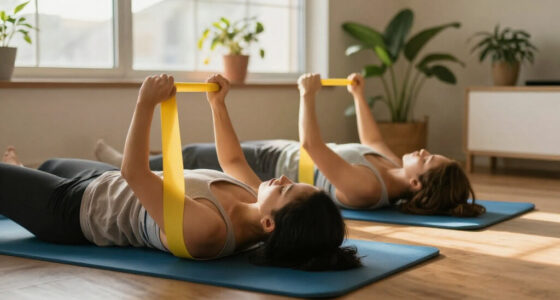
The routine uses a long loop resistance band and, ideally, a short loop band. A long band doubled over can substitute for the short loop. Marinovich’s plan calls for three rounds, with 45 seconds of rest between rounds. The report lists 10 pull-aparts, 10 glute bridges and five bird dogs on each side per round.
For a band pull-apart, hold the long band in front of the chest with both hands and arms relatively straight. Pull the band outward by drawing the shoulder blades together, pause briefly, then return slowly. For a banded glute bridge, lie on your back with knees bent and a short loop above the knees. Engage the core, press through the heels to lift the hips, gently push the knees outward against the band, pause for two seconds and lower with control.
The third exercise, the bird dog, begins on hands and knees with the spine held flat. Slowly extend one arm forward and the opposite leg behind, keeping the hips and torso steady and avoiding a dip in the lower back. Pause for two seconds, return to the starting position and switch sides. These are the instructions in the report; readers should stop if a movement causes or worsens pain and seek professional guidance about suitable modifications.
Strength Work for Everyday Movement
The routine focuses on muscles that help support posture and movement, rather than abdominal exercises aimed mainly at appearance. Marinovich describes the back, glutes and deep stabilisers as a “posterior armour” that helps people stand and move. That is her explanation for the workout’s emphasis, not evidence that this specific sequence prevents back pain.
For readers, the practical value is a short, equipment-light set of movements that can be discussed with a doctor or physical therapist. Maintaining strength may be relevant to everyday tasks such as standing from a chair, but individual causes of back pain and exercise tolerance vary. The source does not report clinical testing, outcomes or a comparison with other exercise plans.
Products Worth Considering

Philips Sonicare 6500 Series Rechargeable Electric Toothbrush with 2 Brush Heads, White

Therabody SmartGoggles 2nd Gen Heated Eye and Temple Massager

Fitbit Sense 2 Health and Fitness Smartwatch, Shadow Grey/Graphite
As an affiliate, we earn on qualifying purchases.
How the Routine Is Framed
The Fit&Well report says lower-back pain can affect quality of life and becomes more common with age. It recommends speaking with a health professional before beginning exercises for back pain, and says strength training may be useful if a doctor or physical therapist recommends it.
Marinovich is identified as a personal trainer, menopause coach and podcast host. The workout is presented as a 10-minute routine for people seeking to move with less stiffness and maintain physical independence. The source provides exercise instructions and Marinovich’s rationale, but does not identify a study establishing that the routine reduces pain or prevents future episodes.
“It moves away from aesthetic-driven abdominal work and focuses on the ‘posterior armour’—the back, glutes and deep stabilisers that keep you standing tall and moving safely.”
— Anneli Marinovich, as quoted by Fit&Well
Evidence and Individual Suitability
The source does not provide clinical trial results, measured pain outcomes or evidence that this exact workout prevents lower-back pain. It also does not specify who should avoid particular movements, how to adapt them for different conditions, or how quickly a person might expect to notice a change. Marinovich’s descriptions are attributed trainer comments, not findings from a medical study cited in the report.
Whether the routine is appropriate depends on a person’s health, symptoms and ability to perform the movements comfortably. The report’s recommendation to consult a doctor or physical therapist before exercising for back pain remains relevant, especially for anyone with existing symptoms or a diagnosed condition.
Discussing a Safe Starting Point
The report does not announce a follow-up study or scheduled update. Anyone interested in trying the routine can first ask a doctor or physical therapist whether these movements are suitable, then seek guidance on form, range of motion and any needed modifications. The source’s suggested format is three rounds with 45 seconds of rest between rounds, but it does not establish that this schedule suits every person.
Readers should treat changes in comfort or function as individual experiences, not proof that the routine works for everyone. If an exercise causes pain or symptoms worsen, stop and contact a health professional for advice.
Key Questions
Which three exercises are in the routine?
The routine includes resistance-band pull-aparts, banded glute bridges and bird dogs. The report gives 10 repetitions of each of the first two and five bird dogs per side in each round.
How many rounds does the workout recommend?
Marinovich’s routine calls for three rounds with 45 seconds of rest between rounds. The report does not say that this format is suitable for everyone.
Can these exercises prevent or treat lower-back pain?
The report presents the exercises as strength work aimed at supporting movement and reducing discomfort, but it does not provide clinical evidence that this specific routine prevents or treats back pain. Consult a health professional about symptoms and exercise choices.
What equipment is needed?
You need a long loop resistance band and, ideally, a short loop band. The report says a long band can be doubled over as an alternative.
Source: fitandwell.com