
TL;DR

Get workout gear delivered free with Prime
- Fast, free delivery on millions of items
- Prime Video, Amazon Music and more included
- Member-only deals all year
A Fit&Well writer and certified personal trainer said their mid-back pain eased after practicing offset child’s pose daily for two weeks. The account describes one person’s experience, not a clinical trial, and does not establish that the stretch treats back pain generally.
A Fit&Well writer and certified personal trainer reported that their mid-back pain was “pretty much gone” after nine days of a two-week routine of offset child’s pose, a gentle stretch performed with the arms reaching to each side. The account is a single-person experience, not evidence from a controlled study, so it cannot show whether the stretch would help other people or establish that it caused the reported change.
The writer said the discomfort had been nagging and tended to flare when they picked up their toddler-aged son. They chose the stretch because it was easy and gentle, and initially held it for 30 seconds on each side. They practiced twice daily at first, then cut back to once a day after their back began to feel better around the midpoint of the experiment.
Over the two weeks, the writer gradually lengthened the holds: first to 45 seconds as the pose became more comfortable, then to 60 seconds on each side during the final three days. They also reported being able to reach farther to each side and lower their chest and hips closer to the floor. The article does not provide a standardized pain score, physical examination or comparison with another routine.
Physical therapist Dr. Michael Nula said the position lengthens muscles along the mid and lower back while the hips and knees move through a comfortable range. He said it may help relieve muscle tension and reduce joint compression. Nula cautioned against forcing the pose, suggesting a pillow for people whose hips do not comfortably reach their heels. The article advises readers with medical conditions or injuries, or concerns about trying the stretch, to consult a physician.
What One Stretch Can—and Cannot—Show
The report may interest people looking for a low-intensity movement to add to a mobility routine, especially because the writer described practical changes: sitting more comfortably and finding it easier to carry their child. But one person’s improvement does not establish a treatment effect. Back discomfort can have different causes, and the account does not say whether other factors changed during the same two weeks.
The distinction matters because a headline about pain “practically” being fixed can sound like a general promise. The evidence presented is narrower: one writer’s symptoms eased while they practiced a stretch. Nula’s comments explain a possible mechanical rationale, but they are not findings from a trial testing the pose as a treatment. Readers with persistent, worsening or concerning symptoms should not use this account as a diagnosis or a substitute for professional advice.
Products Worth Considering

Garmin Forerunner 570 GPS Running Smartwatch, 47mm, Aluminum, Black

Fitbit Sense Health & Fitness Smartwatch (White/Gold, International Version)

Hyperice Normatec Elite Wireless Compression Boots, Standard Size
As an affiliate, we earn on qualifying purchases.
How the Two-Week Routine Worked
The writer described having recently neglected flexibility work before the mid-back discomfort began bothering them. Their experiment was informal: they selected offset child’s pose, practiced it consistently for two weeks and adjusted the hold according to comfort. The report says mobility started to improve after a few days and pain had eased substantially by day nine.
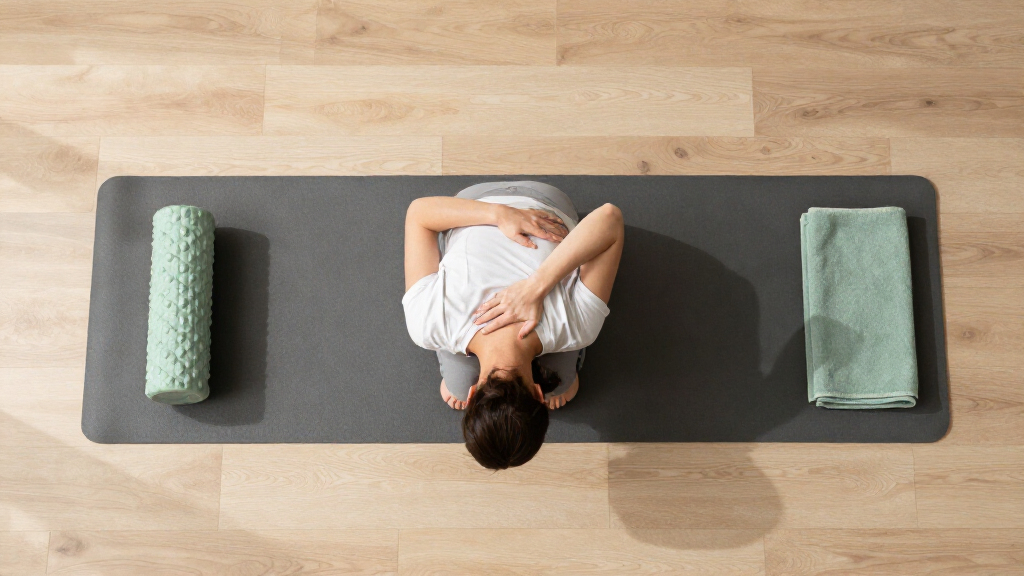
To perform the variation described, a person starts on hands and knees, widens the knees, brings the toes together and sits the hips back toward the heels. Both arms then reach to one side for 30 to 60 seconds, followed by the other side for the same duration. Nula’s advice was to avoid forcing the position and use a pillow if the hips do not comfortably reach the heels. The article gives no broader exercise protocol or clinical assessment of the writer’s pain.
Limits of a Personal Pain Report
The report does not establish what caused the writer’s pain, how severe it was on a clinical scale or whether it would have eased without the stretch. It also does not describe other changes in activity, sleep, workload or care that might have affected symptoms. No control group or longer-term follow-up is reported.
It is also unclear whether the same routine would be comfortable or appropriate for people with different injuries, mobility limits or medical conditions. The source advises consulting a physician when there are relevant conditions, injuries or reservations. The writer’s reported improvement should not be read as a guarantee or as evidence that the pose is suitable for everyone.
The Writer Plans Ongoing Practice
The writer said they intended to keep offset child’s pose in their routine several times a week, while acknowledging they might not practice it daily. The report does not describe a planned follow-up measurement or further testing, so it is unknown whether the improvement lasted beyond the two-week experiment.
For readers considering the movement, the source’s practical guidance is to use a comfortable range, avoid forcing the stretch and seek professional advice if an injury or medical condition could affect whether it is appropriate. Any broader conclusion about its effect on mid-back pain would require evidence beyond this individual account.
Key Questions
Did the stretch cure the writer’s mid-back pain?
The writer reported that the pain was “pretty much gone” after nine days of practice. That is a personal observation; the report does not establish that the stretch caused the improvement or that it cures back pain.
How long did the writer hold offset child’s pose?
They began with 30 seconds on each side, later increased to 45 seconds, and reached 60 seconds per side during the final three days. They practiced twice a day at first, then once daily after symptoms began to improve.
How is the offset variation performed?
Start on hands and knees, widen the knees, bring the toes together and sit the hips back toward the heels. Reach both arms to one side for 30 to 60 seconds, then repeat on the other side. The source advises not forcing the position and suggests a pillow if the hips do not comfortably reach the heels.
Is the stretch suitable for everyone with back pain?
The report does not establish that it is suitable for everyone. It advises people with medical conditions or injuries, or anyone unsure about the pose, to consult a physician. The article does not assess individual readers’ symptoms or mobility.
Source: fitandwell.com