
TL;DR

Get workout gear delivered free with Prime
- Fast, free delivery on millions of items
- Prime Video, Amazon Music and more included
- Member-only deals all year
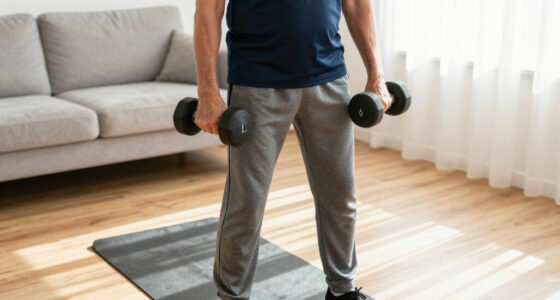
Personal trainer Pippa Sealey says shorter rest periods and unilateral exercises can make home dumbbell training more challenging when heavier weights are not available. A Fit&Well workout applies those methods through supersets and tri-sets, but it is aimed at people already comfortable with basic strength exercises.
Personal trainer Pippa Sealey recommends pairing shorter rest periods with unilateral exercises to keep home dumbbell workouts challenging when heavier weights are not available. In a Fit&Well report, she shared a routine using supersets and tri-sets, designed for people who already know fundamental movements such as squats and deadlifts.
Sealey said she uses shorter rests and movements performed on one side at a time rather than bilateral exercises, which work both sides together, when training at home without access to heavy loads. The approach changes how demanding a session feels without requiring people to buy more equipment. It does not mean the workout replaces progressively heavier weights for everyone; the report presents it as an option when heavier loads are unavailable.
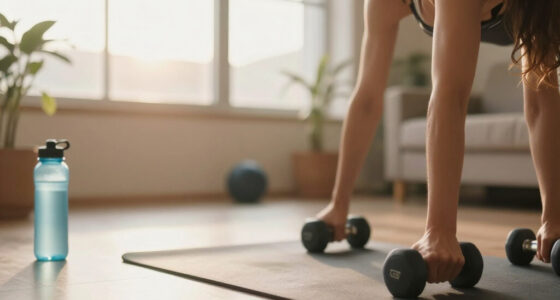
The workout groups exercises into supersets and tri-sets: participants complete one set of each movement in a group before resting, then repeat the sequence three times before moving on. The listed exercises include deficit calf raises, hamstring bridge marches and wall sits, followed by single-leg Romanian deadlifts and split squats. Later groups include push-ups, a single-arm dumbbell push press, rows, core exercises and a plank dumbbell pull-through.
Rest periods vary by group. Several paired movements have no scheduled rest between exercises, while the routine specifies 60 to 90 seconds of rest after some groups. Repetitions also differ: the workout calls for 12 repetitions on each side for some movements, while push-ups are performed for as many controlled repetitions as possible. The source advises maintaining good form rather than continuing when technique breaks down.
Making Limited Home Weights Work Harder
The advice addresses a common limitation of home strength training: people may have a fixed set of dumbbells and find the same load less challenging over time. Single-sided movements ask one limb to do more of the work at a time, while shorter rests and exercise pairings can make a session denser. These are practical ways to vary a workout without adding equipment.
The guidance is not a promise of a particular fitness result, and the supplied report does not provide research comparing this routine with other training plans. Its value for readers is more specific: it offers a structured way to vary familiar exercises when heavier dumbbells are not an option. Readers should choose a load and movement variation they can control, and stop if pain or loss of form occurs.
Products Worth Considering

BowFlex Results Series SelectTech Adjustable Dumbbells (Pair)

BowFlex Results Series SelectTech 552 Adjustable Dumbbell

Levoit Eleva 300X HEPA Air Purifier for Home and Bedroom
As an affiliate, we earn on qualifying purchases.
How the Workout Is Structured
Sealey’s two suggestions are connected in the published routine. A superset pairs one exercise with another before a rest; an agonist superset pairs exercises that target the same muscle group, a variation Sealey also recommends. A tri-set follows the same structure but includes three exercises. The report says to complete each sequence three times before advancing to the next group.
The routine is presented for people already confident with basic strength movements, rather than as a beginner introduction. Its examples mix dumbbell work with body-weight exercises, including push-ups, wall sits and planks. The supplied source material includes instructions for several movements but does not provide complete instructions for every exercise in the workout, so readers should consult a qualified trainer or reliable demonstration if they are unsure about technique.
““You may also want to use more agonist supersets.””
— Pippa Sealey, as quoted by Fit&Well
Limits of the Published Advice
The report does not state when the article was published in the supplied material, nor does it provide evidence that the routine produces a particular strength or fitness outcome. It also does not specify how readers should progress the plan over time, how often to perform it, or what dumbbell weights to choose. The advice is attributed to Sealey as a trainer’s approach, not presented as a universal prescription.
Some details in the supplied workout are incomplete: the exercise list includes a single-arm dumbbell row and other movements for which the provided material does not contain full instructions. Readers should not infer missing form guidance from the brief list alone. People with injuries, health conditions or uncertainty about safe exercise technique may need individualized advice from a qualified professional.
How Readers Can Apply the Routine
The source gives no scheduled follow-up or next publication milestone. Readers considering the workout can first check that they are comfortable with its foundational movements, then use a manageable dumbbell load and controlled technique. The written plan calls for three rounds of each exercise group, with rests specified after some groups; it does not provide a broader weekly schedule.
For anyone who cannot maintain form, the appropriate next step is to reduce the repetitions, adjust the movement or pause the session rather than forcing the target. A trainer can help adapt the exercises and load to an individual’s experience and circumstances.
Key Questions
What are Sealey’s two main suggestions?
She recommends shorter rest periods and unilateral movements, which work one side at a time, when heavier weights are not available at home.
What is a superset in this workout?
A superset means completing one set of an exercise and then a set of another exercise before resting. The workout also uses tri-sets, which group three exercises in the same way.
Who is the routine intended for?
The Fit&Well report says it is designed for people already confident performing basic movements such as squats and deadlifts, rather than people learning those exercises for the first time.
Does the routine require heavier dumbbells?
No. The stated purpose is to make sessions more challenging through exercise choice and rest timing without needing to buy heavier equipment. The source does not claim that these methods are a replacement for heavier loads in every training plan.
Source: rss