
TL;DR

Get workout gear delivered free with Prime
- Fast, free delivery on millions of items
- Prime Video, Amazon Music and more included
- Member-only deals all year
Fit&Well published a 10-minute, three-exercise kettlebell routine aimed at developing core stability at home. Certified kettlebell specialist Faith Ellis recommends starting with a manageable weight and prioritizing form; the source does not provide research showing how much strength users can expect to gain or how quickly.
Fit&Well has published a 10-minute kettlebell routine built around three exercises intended to challenge core stability at home. Certified kettlebell specialist Faith Ellis recommends a half-kneeling halo, a single-arm suitcase carry and a dead bug with a kettlebell pullover, while advising beginners to focus on controlled movement and a neutral spine before increasing weight.
The suggested workout has three sets of each exercise, with different repetition or time targets. For the half-kneeling halo, the source recommends four circles in each direction on each side. Start in a half-kneeling position, hold the kettlebell by its horns at chest height, and circle it around the head while keeping the hips square. Fit&Well lists a starting weight of 10–18 pounds (4–8 kilograms).
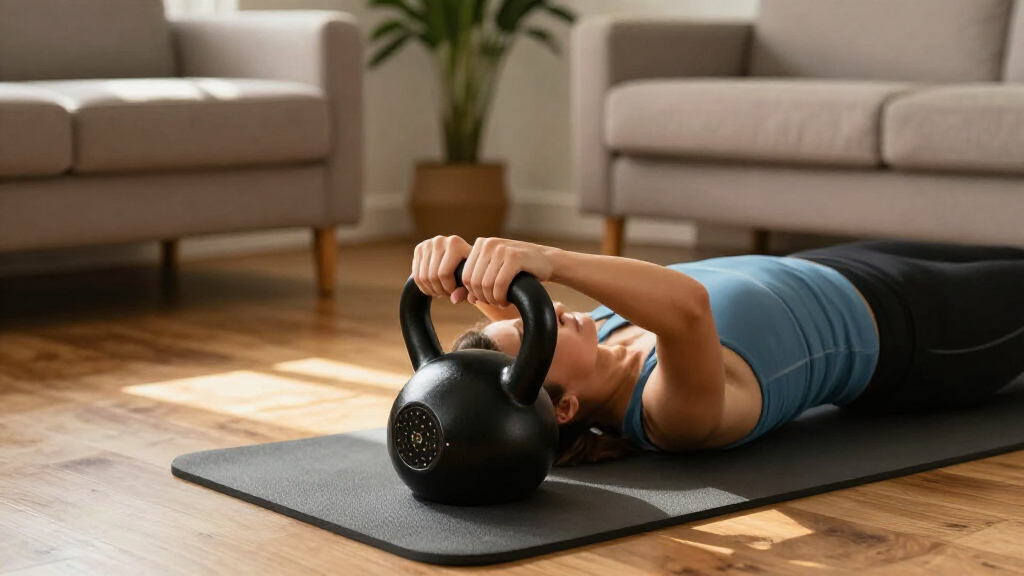
The suitcase carry is prescribed for 30 seconds on each side per set. Hold the kettlebell at one side and walk forward at a controlled pace, then switch hands. The source suggests starting around 18–26 pounds (8–12 kilograms). For the dead bug variation, lie on the floor holding a light kettlebell above the chest, with knees bent over the hips. Lower one leg while moving the weight behind the head, then return to the starting position and alternate sides for six to eight repetitions per side. The suggested starting load is 10–18 pounds.
Ellis advises choosing a weight that allows good form and breath control. She says to add load only once a set feels easy to complete with proper technique; alternatives include adding repetitions or slowing the movement. Fit&Well describes these as beginner-friendly exercises, but does not say that every beginner will be ready for the same weight or movements.
A Short Routine for Home Training
The routine gives readers a structured option for a brief home session using one piece of equipment. Its movements emphasize resisting unwanted torso rotation or bending, rather than relying only on repeated spinal flexion. That makes the workout distinct from a core session based solely on crunches, though the source does not compare outcomes between exercise approaches.
It may be useful for people seeking a simple sequence with specified loads and work targets, but the 10-minute framing should not be read as evidence of a guaranteed result. Fit&Well provides no trial data, strength measurements or timeframe for changes in core strength. Results would depend on factors such as regular practice, appropriate loading and each person’s starting point.
Products Worth Considering

Bowflex SelectTech 840 Adjustable Kettlebell

BowFlex Results Series SelectTech Adjustable Dumbbells, Pair

Philips Sonicare 5950 Rechargeable Electric Toothbrush with 2 Brush Heads, Pink
As an affiliate, we earn on qualifying purchases.
Ellis’s Guidance on Kettlebell Technique
Fit&Well presents Ellis as a certified kettlebell specialist and founder of The KettleBelle. In the report, she describes kettlebells as versatile equipment that can be used for strength, mobility and cardiovascular exercise. Those are her general comments about the equipment, not findings from a study included in the article.
Her explanation for the workout’s core focus is that single-arm and offset exercises ask the trunk to stabilize and resist rotation or side-bending. The three selected movements apply that idea in different positions: kneeling while circling a weight, walking while carrying it on one side, and coordinating arm and leg movement while lying down. The source recommends gradual progression rather than starting with heavier loads.
“Kettlebell exercises require the core to stabilize and transmit force rather than just flex the spine.”
— Faith Ellis, certified kettlebell specialist and founder of The KettleBelle, as quoted by Fit&Well
Evidence and Individual Readiness
The report does not identify a study testing this exact sequence, quantify expected strength gains or explain how the 10-minute duration was calculated. It also does not provide modifications for people with injuries, pain, balance limitations or other health concerns. The suggested starting weights are ranges, not individualized prescriptions, and a load that suits one person may be too heavy or too light for another.
It is also unclear whether the timing includes rest between sets and exercises. The source lists three sets for each move but does not give rest periods or a complete schedule, so total workout time may vary. Readers should stop if an exercise causes pain and seek qualified guidance if they have a pre-existing condition or are unsure whether kettlebell training is appropriate.
How to Progress the Exercises
Ellis’s progression advice is to first complete the prescribed work with consistent technique and controlled breathing. When a set feels easy and form remains sound, the source suggests adding repetitions, slowing the repetitions or increasing the kettlebell by 4–8 pounds (2–4 kilograms). It does not specify a weekly schedule or require readers to increase weight.
For anyone trying the routine, the next practical step is to select a manageable load, learn each movement without rushing and adjust the session to individual ability. Fit&Well’s report offers exercise instructions rather than a monitored training plan, so it does not establish how often to repeat the workout or what results to expect.
Key Questions
What exercises are in the kettlebell routine?
The three moves are a half-kneeling kettlebell halo, a single-arm suitcase carry and a kettlebell dead bug with a pullover variation.
What weights does the report suggest for beginners?
Fit&Well lists 10–18 pounds (4–8 kilograms) for the halo and dead bug, and around 18–26 pounds (8–12 kilograms) for the suitcase carry. These are source recommendations, not personalized guidance; choose a load you can control with sound form.
Does the workout take exactly 10 minutes?
The report describes it as a 10-minute workout, but does not specify rest intervals or explain whether transitions are included. The actual time may vary.
How should someone increase the difficulty?
Ellis advises progressing only when the set feels easy with good form. The report suggests adding repetitions, slowing the movement or increasing the load by 4–8 pounds (2–4 kilograms).
Is the routine suitable for everyone new to exercise?
The report calls the moves beginner-friendly, but it does not assess individual fitness or health needs. Start cautiously, stop if there is pain, and ask a qualified professional for advice if you have a pre-existing condition or are uncertain about the exercises.
Source: fitandwell.com