TL;DR

Get workout gear delivered free with Prime
- Fast, free delivery on millions of items
- Prime Video, Amazon Music and more included
- Member-only deals all year
A Fit&Well writer has shared a home dumbbell workout built around four paired push, pull, biceps and triceps exercises. The routine calls for six to eight repetitions per side on three weighted moves, as many knee push-ups as possible, two minutes of rest and three rounds; the report does not provide independent evidence of results.
Fit&Well has published a writer’s four-move dumbbell arms workout for people who have less time for gym training, with the writer describing how they fit it into a home routine. The plan pairs pressing and rowing with a hammer curl and a knee push-up, and prescribes three rounds with two minutes of rest between rounds. It is a personal training account, not a study showing that the routine produces particular results.
The writer says their schedule has shifted from sessions of up to two hours, five times a week while training for CrossFit competition to three sessions of about 30 minutes each. They describe their current goal as maintaining mobility and strength. Combining push and pull work with direct arm exercises is presented as a way to use one session rather than separate push and pull days.
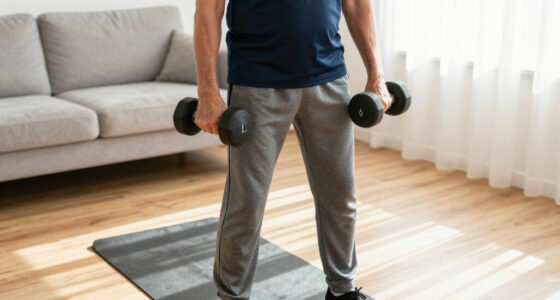
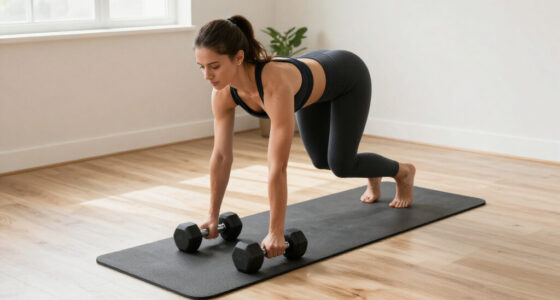
The sequence starts with a half-kneeling single-arm press, followed by a single-arm bent-over row and a single-arm hammer curl. Each weighted movement is prescribed for six to eight repetitions on each side. The fourth exercise is a triceps push-up; the writer’s instructions describe beginning on hands and knees, then stepping the knees back into a straight-body position and lowering the chest. The recommendation is to do as many repetitions as possible.
After all four exercises, the plan calls for two minutes of rest and a total of three rounds. The writer advises choosing a weight that makes the final repetitions challenging, increasing it slightly when eight repetitions become easy, and reducing it if eight cannot be completed. The article describes using one dumbbell at a time; it does not specify a universal weight suitable for all readers.
A Shorter Routine for Home Training
The account offers readers a specific format for combining arm and upper-body work when long gym sessions or separate training days are not practical. Using a single dumbbell and a bodyweight exercise means the routine can be adapted for home use, although the reader still needs a safe place to perform the supported row and enough room to kneel and move.
The exercise selection also reflects the writer’s view that arm training need not consist only of isolated curls and extensions. Presses and rows involve the shoulders and back alongside the arms, while the push-up adds a bodyweight movement. That is the writer’s rationale for the sequence, rather than a claim that this particular workout is superior to other programs. The source provides no measured outcomes, comparison group or evidence that following it will guarantee strength or muscle gains.
Products Worth Considering

Bowflex SelectTech 840 Adjustable Kettlebell

BowFlex Results Series SelectTech Dumbbells

Levoit Vital 100 Air Purifier for Home Bedroom
As an affiliate, we earn on qualifying purchases.
Why the Writer Changed Training
The workout grew out of a change in the writer’s available training time. They report having once trained for CrossFit competitions with sessions lasting as long as two hours, five days per week, but now doing three half-hour workouts weekly. The source does not state when that change began or give a dated training log.
The writer says the half-kneeling press suits them while recovering from a lower-back disc injury. They describe the position as limiting help from the legs and reducing the chance of arching the lower back excessively. This is a personal explanation, not medical guidance or evidence that the movement is safe for others with back conditions. The report also identifies the equipment as cast-iron spinlock dumbbells from Mirafit, noting that the brand is UK-only and naming CAP Barbell as a similar option in the United States.
““The older I get, the busier life gets, so my training has had to adapt.””
— Fit&Well writer
Results and Individual Suitability
The source gives no publication date in the material provided and does not report how long the writer has followed this workout, what measurable changes they experienced, or whether the routine has been tested against another program. The headline’s reference to still getting results is not supported by outcome data in the article excerpt. Results will vary, and the routine is not presented as an individualized training plan.
It is also unclear what dumbbell weight the writer uses, how long the full session takes, or how the plan should change for people with different experience levels, equipment or injuries. The writer’s mention of recovering from a back injury should not be taken as a recommendation for others with back pain. Anyone with a pre-existing condition or uncertainty about exercise technique can seek guidance from a qualified health or fitness professional, and movements should be stopped if they cause pain.
How Readers Can Apply the Plan
The source does not announce a follow-up test, new program or later update. Readers who choose to try the sequence can follow the listed order and repetition guidance, use a load they can control, and rest for two minutes between the three rounds. The bent-over row requires a stable support for the free hand; the workout should be adapted if equipment or space is unavailable.
As with any exercise routine, readers should prioritize controlled movement over adding weight or repetitions. The report gives a progression cue—raise the weight slightly when eight repetitions are easy—but does not set a timeline or promise a particular result. Further reporting would be needed to establish how the workout affects strength, mobility or other outcomes over time.
Key Questions
What exercises are in the workout?
The routine includes a half-kneeling single-arm press, a single-arm bent-over row, a single-arm hammer curl and a triceps push-up.
How many repetitions and rounds does it prescribe?
Do six to eight repetitions per side for each of the three dumbbell exercises, then as many triceps push-ups as possible. Rest for two minutes after the sequence and complete three rounds.
Does the report prove the workout gets results?
No. The article is a writer’s personal account and provides no measured outcomes or independent testing. Its headline refers to results, but the supplied report does not quantify them.
Is the routine suitable for someone with a back injury?
The writer says they use the half-kneeling press while recovering from a disc injury, but that personal experience is not medical advice. People with a back condition should seek guidance from a qualified professional before trying or adapting the exercises.
Source: fitandwell.com