TL;DR

Get workout gear delivered free with Prime
- Fast, free delivery on millions of items
- Prime Video, Amazon Music and more included
- Member-only deals all year
Fit&Well published a personal trainer’s 10-minute, no-equipment strength circuit intended for clients over 60. The routine uses three exercises, performed for 10 repetitions each and repeated for three circuits; the report advises modifying movements for comfort and using support when needed.
Fit&Well has published a personal trainer’s 10-minute, at-home strength circuit for clients over 60, combining chair squats, wall push-ups and standing knee-to-elbow movements without equipment. The report says to perform each move for 10 repetitions, complete three rounds and rest briefly as needed, while adjusting the exercises for ability and balance.
The routine is presented as an option for older adults to do at home between sessions with a trainer. It works the lower body, upper body and core, according to the Fit&Well report. Its suggested pace is three full circuits in about 10 minutes, but the article says it is acceptable for the session to take longer at first.
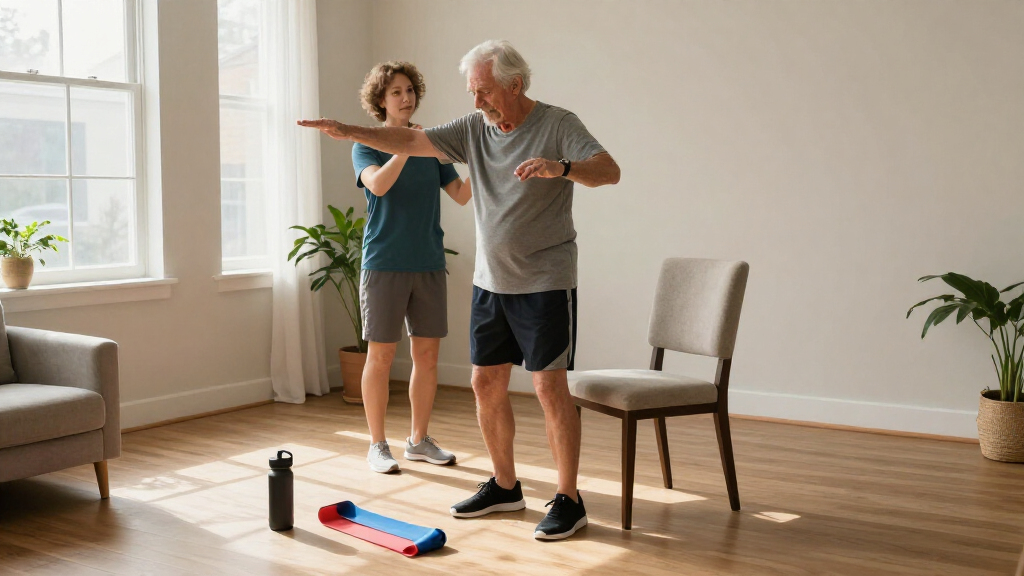
For the chair squat, stand in front of a chair, lower toward its seat by bending at the hips and knees, then stand again. The trainer’s instructions say to tap the seat or sit fully if needed, and to hold a wall or another solid structure for support when necessary.
The other exercises are wall push-ups and standing knee-to-elbow movements. For the push-up, face a wall, place both hands against it, bend the elbows to bring the chest closer, then push back. For the knee-to-elbow move, alternate bringing one knee up toward the opposite elbow. The report recommends moving within a comfortable range and holding a wall or chair if balance is an issue.
A Home Routine With Modifications
The routine offers a simple structure for people who want to practise strength movements at home without buying equipment. Its chair and wall-based options provide accessible ways to scale the exercises: sitting fully during a squat, standing closer to the wall for an easier push-up, or using a stable support during the balance-demanding movement.
That does not make the circuit suitable for everyone. The report cautions that exercises can cause pain or injury if performed incorrectly, and says a personal trainer can help teach form and judge when someone is ready to progress. Readers with pain, mobility limitations or health concerns should seek appropriate professional guidance before starting or changing an exercise routine.
Products Worth Considering

Levoit Eleva 300X HEPA Air Purifier for Home and Bedroom

Fitbit Versa Smart Watch – Black Aluminum, One Size (S & L Bands Included)

Therabody JetBoots PRO Plus Wireless LED 3-in-1 Compression Boots, Short (29 in Inseam)
As an affiliate, we earn on qualifying purchases.
How the Three-Move Circuit Works
The Fit&Well report describes the session as a circuit: complete 10 repetitions of each exercise, then return to the first move after finishing all three. It suggests repeating the circuit until three rounds are done, with short rests between exercises. The stated 10-minute duration is an estimate, not a required pace; the report explicitly allows more time while someone practises.
Its suggested frequency is three to four times per week. The article also says the routine could be split across the day, such as once in the morning, afternoon and evening. It does not provide research findings showing that this particular sequence produces a specific level of strength improvement, nor does it describe the routine as a substitute for individualized exercise advice.
“Doing three full circuits should take around 10 minutes if you’re resting briefly between exercises.”
— Fit&Well report
Individual Suitability and Evidence
The report does not identify the trainer by name in the supplied material, provide a publication date, or cite studies evaluating this exact circuit. It also does not specify how the routine should be adapted for particular medical conditions, injuries or mobility needs. The suggested frequency and 10-minute duration are general guidance in the article, not individualized recommendations.
It remains unclear how much strength benefit a person may receive, since results depend on factors such as starting ability, technique and consistency, and the source gives no measured outcomes. The routine should not be treated as universally appropriate; people who are unsure whether the movements are suitable can consult a qualified professional.
Starting Slowly and Checking Form
The report gives no scheduled follow-up or additional milestone. For readers who choose to try the circuit, its practical next step is to begin at a manageable pace, rest when needed and use a chair or wall for support where appropriate. The stated target is three rounds of 10 repetitions per move, but completing the session safely matters more than meeting the estimated time.
Participants can seek a personal trainer’s help with technique and progression, as the report recommends. Anyone experiencing pain or difficulty with balance should stop or modify the movement and seek professional advice suited to their circumstances.
Key Questions
What exercises are included in the routine?
The circuit includes chair squats, wall push-ups and standing knee-to-elbow movements. No equipment is specified, though a stable chair and wall are used for the exercises and support.
How many repetitions and rounds does the report suggest?
Perform 10 repetitions of each move, then repeat the three-exercise circuit for three rounds. The knee-to-elbow movement is described as 10 repetitions on each side.
How often does the article recommend doing it?
The Fit&Well report suggests doing the workout three to four times per week. It says the routine may also be divided into shorter sessions across the day, but this is general guidance rather than personalized advice.
What if an exercise feels difficult or affects balance?
The report suggests sitting fully before standing during chair squats if tapping the seat is too challenging, and holding a wall or chair for support when balance is a concern. Work within a comfortable range and seek professional guidance if you are uncertain about form or suitability.
Source: rss